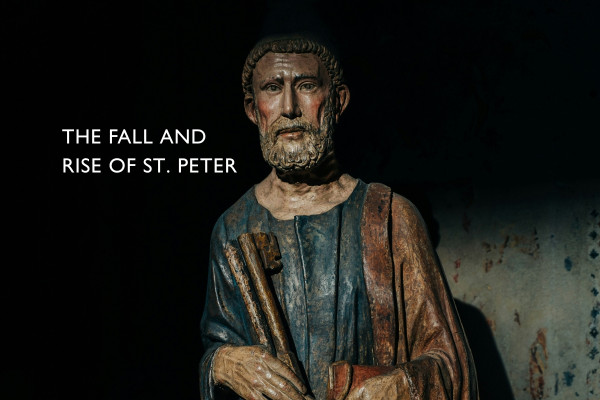
As we enter this season of Lent, let us befriend St. Peter, the rock of our Church. His love for Christ was immense, his passion unmatched, his heart was willing, yet his feet struggled to follow. The falls of Peter were great, but the love of Christ even greater. The conversion of St. Peter is a story we can find ourselves in, our Mother Foundress, Bl. Frances Siedliska offered this powerful reflection to her daughters back in 1883. May her insights into the life of St. Peter bring about our own conversions to Christ this Lent.
As a help in avoiding sin and recognizing the road back to God, it is advisable to meditate, against the background of Christ's Sacred Passion, upon the history of the fall and the rise of the Apostle Peter. Prompted to follow Christ by his love for Him after His capture by the Temple guards, he was held back by his concern for personal welfare and safety, and by fear. Therefore, he followed Christ but "from a distance." Similar circumstances occur in [our] life. [We] also should be following [our] Master closely; but sloth, carelessness and indifference, reluctance and softness lead [us] to a betrayal of Christ in action.
The second reason for Peter's fall was his presumptuousness; he trusted himself to the degree that, even though the Divine Master Himself foretold his fall, Peter would not believe it. This holds a lesson for us. The first denial by Peter typifies lack of faith in those who did not admit Christ's Divinity before His Sacred Passion; the second denial symbolizes those for whom Christ's Divinity and Humanity, after the time of His glorious Resurrection, became "a rock of scandal" (1 Peter 2:8). Finally, Peter's third denial denotes a search for exterior satisfaction or gratification and an avoidance of penance and mortification. The fire of love glowed very low in the heart of Peter and, instead of igniting it anew through prayer and a closer approach to Christ, the Apostle turned to self, to external things; he began to warm his body; the material fire increased his spiritual weakness.
This same Peter, who defended his Master with the sword in the Garden of the Agony when danger threatened His Divine Person, now, when he actually witnesses His grave humiliations, denies Christ, trembles at the voice of a mere maid-servant accusing him to be one of His men... How grave an evil it is for us not to avoid occasions of sin or to parley with temptations! Peter did not deny Christ immediately. At the first challenge, he answered the maid-servant, "I do not know what you are saying" (Mt. 26:70). At the second questioning, Peter denied that he knew "the Man" (Mt 26:72). Finally, after the third accusation, Peter "began to curse and to swear that he did not know THAT Man" (Mt. 26:72). Our obduracy in sin increases the guilt itself, and he who makes light of small matters falls into greater ones. That is why the Sacred Scriptures reproach all sluggards with the words, "Awake as you should, and do not sin" (1 Cor. 15:34).
After Peter's third denial, the cock crowed, "And the Lord turned and looked upon Peter" (Lk. 22:61). With His Sacred look, Christ awoke sincere contrition within Peter's heart, as a result of which "Peter went out and wept bitterly" (Lk. 22:62). Only the look of Christ can prompt the sinner to such sincere amendment, to tears and contrition, because whoever once beholds such prodigious Incarnate Light cannot remain in the darkness of sin.
Holy Scriptures give us a terse account of the first consequence of Peter's contrition and conversion in the following words, "And he went out and wept bitterly" (Mt. 26:75). "Went out"...Peter could not very well make the proper atonement in the courtyard of Caiphas, so he left the crowd for some privacy in which his contrite tears could wash his guilt. "Went out"... he fled from sin and the occasion to it. This is the first necessary step to true conversion. "And if thy hand or thy foot is an occasion of sin to thee, cut it off and cast it from thee! It is better for thee to enter life maimed or lame than, having two hands or two feet, to be cast into everlasting fire. And if thy eye is an occasion of sin to thee, pluck it out and cast it from thee! It is better for thee to enter into life with one eye, than, having two eyes, to be cast into hell-fire. (Matthew 18:8-9). This is how we should look upon and judge our internal faults and our passions, which must be destroyed by correspondence with grace.
Tears were the second fruit of Peter's conversion. Peter sorrowed and cried throughout the remaining part of his earthly life. It is said that his frequent tears wore deep furrows in his cheeks. Every cock-crow brought fresh tears to his eyes since it was a new reminder of his ignominious betrayal. Those were blessed tears which, like the waters of Baptism, had the power to wash away his sin and to obtain forgiveness. The merciful hand of God saved Peter before he could fall into torpidity and impenitence. So, the Apostle who once lacked the strength to remain faithfully at the side of Christ during His Sacred Passion, remained unmoved and unshaken during his own martydom.
The third and final fruit of Peter's fall, which brought about the amendment of his life, was a right mistrust of self. When Christ asked him three times, after His Resurrection, if he loved Him more than the others, the Apostle was no longer confident in vouching for himself, but humbly replied, "Lord, Thou knowest all things, Thou knowest that I love Thee" (Jn. 21:17). He was now reticent about relying on self, about confiding in his own strength; instead, he turned to Our Lord, hoping to find in Him the assurance of his fervent and stable love for the Beloved Master. It was then that Peter heard the words of full understanding, forgiveness, and trust, "Feed My sheep" (Jn. 21:17). That exalted dignity was now to be the work of his penitent love, as heretofore fear of creatures was the reason for his betrayal and fall from grace.
My dearest [ones]! As we come to the end of this meditation, let us approach those Sacred Wounds of Our Beloved Redeemer in all humility, and reflect that it was our sins, our infidelities, and our lack of love which served as the nails which held Our Lord immovable upon the gibbet of the Cross. But, let us console ourselves in the thought that these Precious Wounds were opened for love of us; hence, let us have great confidence in the unfathomable goodness and love of Our Crucified Redeemer. In meditating upon His Sacred Passion and Death, let us learn how to die to self and to prepare our immortal soul for that great Feast of the Resurrection, so that we also could rise with Him and begin a new life.
Expert from Conferences of Our Mother Foundress, For Lent, 1883, (pg 371-373)