The LORD spoke to Moses and said: Consecrate to me every firstborn; whatever opens the womb among the Israelites, whether of human being or beast, belongs to me. (Exodus 13:1-2)
When the days were completed for their purification - according to the law of Moses, they took him up to Jerusalem to present him to the Lord, just as it is written in the law of the Lord, “Every male that opens the womb shall be consecrated to the Lord,” and to offer the sacrifice of “a pair of turtledoves or two young pigeons,” in accordance with the dictate in the law of the Lord. (Lk 2:22-24).
Healthcare providers are often referred to as “practicing physicians” in their specialty. Many caring professions have “standards of practice” that outline principles and ethical responsibilities professionals must uphold. As a practicing Catholic who ministers in a healthcare setting, this came to mind as I considered the World Day for Consecrated Life. Pope Francis spoke of the Church as “a field hospital after battle” tending wounds – of the poor, needy, strangers, outcasts – and even those we experience as enemies. Bishop Barron described the Church as a “hospital for sinners” in which our role is “to find the lost sheep and bring them back to the flock, not (to) shame them for wandering off.”
Are you a practicing Catholic?
Have you ever thought of vowed members of religious institutes as “practicing religious”? The Gospels, especially the Beatitudes, detail the principles of our faith, a faith-in-action, or “practice.” The vows and our Covenant of Love provide the “standards,” the responsibilities, and framework for our lives. Meditating on the Holy Family in Nazareth reveals that the Sacred is hidden in ordinary life. It was the “ordinary” practice of law that Jewish families consecrated their firstborn to the Lord. In the Church, Baptism is the “ordinary” practice of Christian families to consecrate their children to the Lord. Profession of the evangelical counsels (vows of chastity, poverty, and obedience) expands the “ordinary” consecration one received in the sacraments of Baptism and Confirmation.
The School of Nazareth is where I practice – the art of listening with an open heart, and – handing my life over to the Father’s will, as it is revealed in dialogue. In the field hospital of the Church, I practice – heart hospitality, recognizing we are One family, brothers and sisters; children of a loving Father. I practice – holding space for another’s pain at the foot of the Cross. I practice – forgiveness and mercy when I am tempted to judge. I practice – walking alongside those wounded and – being present to those who grieve. I practice – being silent when words fail. I practice – patience when I desire haste. I practice – holding my tongue when I am tempted to say something unkind. I practice humility and truthfulness when I am tempted to lie. I practice – trust in the face of fear. I practice stillness when I feel compelled to stay busy.
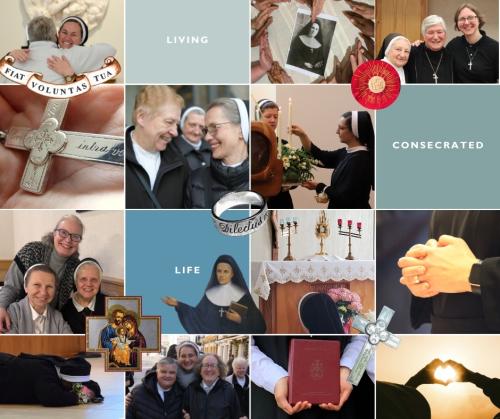
To live a Consecrated Life is to commit oneself to practicing – living out the vows – to rely on the gifts of the Holy Spirit – to live with integrity and virtues – to pray constantly – to live with selfless, inclusive love.
To live in a spousal relationship with the Divine Physician is to practice nursing in the field hospital, where all the wounded can find healing through tender mercy, compassionate presence, and loving patience. Saint Francis was once repulsed at the sight of leprosy, but when he exchanged his gaze from the hideous wounds to the man inflicted, he recognized Christ.
As Jesus demonstrated on the Cross, no wound is too grotesque for redemption, and no one is outside of Divine Mercy who trusts in Him. May we who are consecrated to Him continue to practice the gifts and fruits of the Holy Spirit, deepened in our profession of vows.
Sr. Mary Annette Gailey, CSFN